

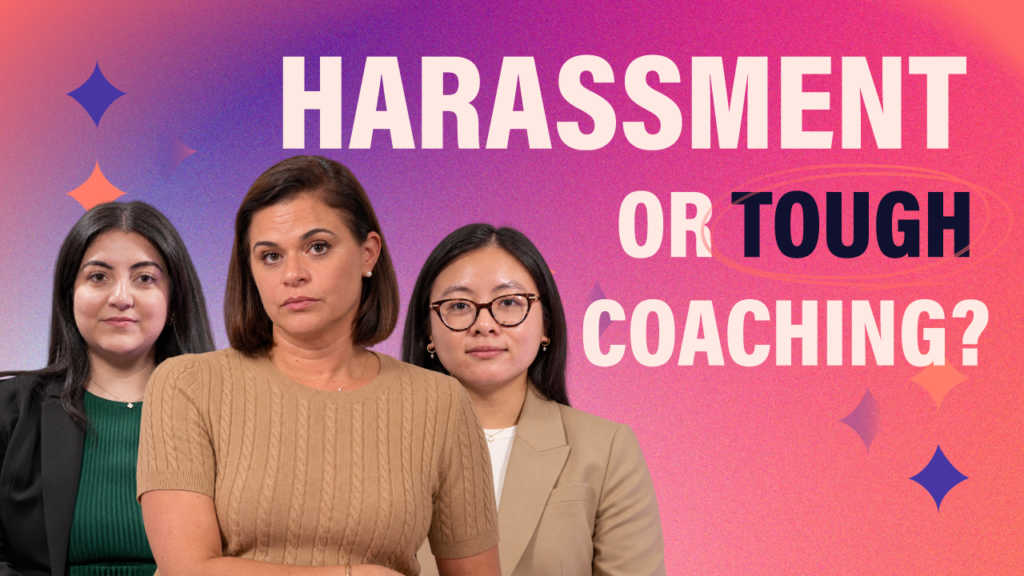

Why can sexual harassment be especially difficult to recognize or report in college sports?
In this episode of Not in the Newsletter, Christina Phillips is joined by employment attorneys Melissa Berouty and Jessica Rosales to examine the power coaches and athletic programs may hold over student athletes. Melissa brings the perspective of a former Division I athlete and collegiate coach, while Jessica draws on her experience as a former Special Victims Bureau prosecutor.
The conversation explores how playing time, scholarships, recruiting relationships, travel, recommendations, and future opportunities can make athletes hesitant to speak up. Christina, Melissa, and Jessica also discuss grooming behavior, Title IX, reporting options, retaliation, documentation, and the differences between student athletes and university employees.
In this episode, you will learn:
- Why the coach controlling an athlete’s future may also be the person crossing the line
- How recruiting relationships can create a power imbalance before an athlete reaches college
- Why conduct may be normalized as intense coaching even when it causes harm
- How Title IX and employment protections may apply differently depending on someone’s role
- Where athletes and athletic department employees may be able to report concerns
- How retaliation may affect playing time, scholarships, travel, assignments, and future opportunities
A college athlete should not have to choose between personal safety and the future they worked years to build.
Most company newsletters highlight promotions, awards, and milestones. They rarely tell the stories behind workplace challenges: reporting harassment, facing discrimination, experiencing retaliation, requesting accommodations, or taking leave to care for yourself or a loved one.
Created by William K. Phillips, founder of Phillips & Associates, and hosted by Christina Phillips, Not In The Newsletter explores the workplace realities employers don’t talk about. Through conversations with attorneys, therapists, advocates, and other experts, the podcast examines employee rights, workplace power dynamics, harassment, discrimination, retaliation, mental health, and the challenges that arise when work and life collide.
Whether you’re facing a workplace issue, supporting someone who is, or seeking a better understanding of today’s workplace, each episode offers practical insights and expert perspectives to help you navigate what’s next.
Episode Transcript
[00:00:00] Christina Phillips: The same person who can control your athletic future can also very much derail it.
[00:00:05] Melissa Berouty: As far as complaining goes, I think that’s the big gray area, and I think that’s the reason we’re seeing a lot of cases come to light, because things are happening to student athletes and they’re being silenced.
[00:00:15] Jessica Rosales: A lot of it starts young, right?
[00:00:16] Jessica Rosales: It starts innocent. It’s about establishing some kind of trust. Once they’re in college, are they gonna report that person they’ve relied on for many years?
[00:00:34] Christina Phillips: Welcome back to Not In The Newsletter. Sexual harassment in college sports can be especially difficult to report when the person involved controls your playing time, scholarship, team standing, or future opportunities. Joining me today are Melissa Berouty, an employment attorney and former Division I athlete and collegiate coach, and Jessica Rosales, an associate attorney and former Special Victims Bureau [00:01:00] prosecutor.
[00:01:00] Christina Phillips: Thanks for joining me. Not sure if what’s happening to you is harassment or retaliation? You’re not alone. HarassmentHelp.org offers practical guidance to help athletes better understand what may be happening and what options may be available. Visit HarassmentHelp.org to learn more What makes sexual harassment in college sports especially difficult to recognize or report when a coach or an athletic department controls an athlete’s future?
[00:01:29] Melissa Berouty: Yeah, so I, I think it’s a, it’s a complex issue. I think that a lot of times, especially– So I played at the Division I level. I think you train for years and years and years to kind of get to that point, and it’s kind of like the, the pinnacle of your career. I remember at that time I felt like my whole identity was being a softball player.
[00:01:48] Melissa Berouty: Um, so I think when you are in that situation and you’re being subjected to sexual harassment or inappropriate conduct, most of the time it probably would be [00:02:00] at the hands of your coach, which is the person that you’re kind of, um, you’ve entrusted your collegiate career with and is the person that’s really supposed to guide you to winning, which when you’re in it feels like the most important thing ever.
[00:02:12] Melissa Berouty: You know, your kind of whole world is wrapped up in, in being successful in your sport. There’s certain realities that comes with that. I think it’s difficult because that person, um, controls your playing time. That person co-controls the athletic scholarship that you’ve received. A lot of student athletes can go to certain institutions that they maybe never otherwise could have because this coach has kind of given them an opportunity to play.
[00:02:37] Melissa Berouty: Um, that being said, I, I think it’s incredibly difficult to kind of come forward in, in that type of situation because the power dynamic is, is undeniable. There are certain avenues that you have where you can complain. Typically, it would be with like an athletic director or a senior woman administrator, but again, that’s kind of complex because those are the exact people who’ve [00:03:00] hired the coach that might be doing this behavior.
[00:03:04] Christina Phillips: Right. Yeah. It’s so tricky. I mean, w- so what do you do as a student athlete, um, when, you know… W- what, what does it look like? What, you know… Like for example, maybe you can show us how it looks in a college sport versus in the workplace. Like what’s happening? I mean, because we know, it– I trained as and I was a professional ballet dancer, and the things that could be said to me in the classroom versus on the, you know, in the theater were a little bit different, but I’m sure it’s a stark contrast for a college athlete.
[00:03:36] Melissa Berouty: Yeah. So I think- In the workplace, it’s a little bit more straightforward. I think there’s typically, or at least there should be, some type of human resources department, and that’s kind of the person that’s entrusted to handle these types of complaints. So I’d say that’s a little bit more straightforward.
[00:03:53] Melissa Berouty: I think when you’re a student athlete, there’s a lot of similarities in the level of control that’s [00:04:00] exercised over you. However, as far as complaining goes, I think that’s the big gray area, and I think that’s the reason we’re seeing a lot of cases come to light, because things are happening to student athletes and they’re being silenced.
[00:04:11] Melissa Berouty: Coaches are being insulated. In theory, there’s administrators and there’s compliance directors at every institution that you should be able to complain to. I think the million-dollar question is what they’re going to do with it.
[00:04:23] Christina Phillips: Mm-hmm. And, um, the thing is, is that this can actually even start before you get to college.
[00:04:28] Christina Phillips: This can start recruiting. So I know you worked with children. I mean, some of the kids that are being recruited can be as young as 13. I think it’s different for every sport. You know, soccer might be one thing, softball is another, football is another. If you haven’t even been– You haven’t received a scholarship from a particular school, but you are being harassed potentially by a coach, because some of the coaches will have programs at a school where they’re gonna train kids, and then they can actually be recruited into that same school If you’re [00:05:00] really young, w- who are you complaining to then?
[00:05:03] Christina Phillips: Or are you just, your parents are guiding you to just move on, or wh- have you seen anything like this?
[00:05:08] Jessica Rosales: So I think that’s an important distinction here when we’re talking about college athletes. We are talking about adolescents in kind of their pivotal developmental years. So, you know, personally, I have experience as a Special Victims Bureau prosecutor, so I’ve worked with, you know, survivors of all kinds of abuse or sexual violence.
[00:05:30] Jessica Rosales: You know, I think the youngest might have been, like, around nine or eight or younger. Um, and I think here, right, we have students who might have been devoted to whatever sport it might be, right? Um, kind of training from a very young age, from elementary, middle school. Um, a lot of it kind of compounds on itself, right?
[00:05:51] Jessica Rosales: If we have a kid, um, trying to get onto the, you know, top varsity team in high school, um, hoping to get recruited. And especially [00:06:00] in this day and age, right, a lot of college is expensive. A lot of people, to get that education, they’re riding on the scholarship. And so I think what we see once a student ends up at college, right, they’ve gotten their dream career.
[00:06:16] Jessica Rosales: They think maybe they could go pro. Um, a lot of that started when they were probably in high school, right? Recruiters coming to campus, um, kind of dangling that, that big trophy that they could have someday, right? Um, and I know just from my experience, um, working with younger victims, a lot of it starts young, right?
[00:06:36] Jessica Rosales: It starts innocent. It’s about establishing some kind of trust, and I think Melissa can speak more to the athletic, um, portion of it, right? But I, I know personally, um, from the work I’ve done, a lot of it is children relying on a trusted adult Um, and that relationship will grow, right? Um, these kids, who have they got to go to, right?
[00:06:59] Jessica Rosales: And it [00:07:00] kind of goes from there, um, that these relationships, like Melissa said, they, it starts young. Um, and then once they’re in college, are they gonna report that person they’ve relied on for many years?
[00:07:11] Melissa Berouty: Yeah, no, I think it’s, like, an interesting thing because the recruiting process, and, like, speaking from when I was a player versus when I was actually the one recruiting, it starts I think you, around maybe, like, 14.
[00:07:23] Melissa Berouty: 13 to 14. You’re in high school. The real reality is that maybe you could compete in college sports. You’ve been training for years and years leading up to that point. So you have all of these people sitting in the stands, watching you play, evaluating whether you’re good enough, um, which I think is a, it’s a scary thing to go through when you’re at that age.
[00:07:44] Melissa Berouty: I think that can do something to someone’s psyche. Then, all of a sudden, there’s this one coach that gives you the opportunity. They give you the offer. You go out to campus. You meet all of your college teammates. You see what life could potentially look like. And it’s up to that coach [00:08:00] and their staff to make a decision, like, “Okay, you’re the one that I want.”
[00:08:04] Melissa Berouty: And you get the scholarship, and you’re there. So this is a, a three-year relationship, to Jessica’s point, that’s kind of been building. This person’s given you what feels like the golden ticket, the opportunity to really compete at that level, the level you’ve always kind of dreamt about, and now you’re there.
[00:08:20] Melissa Berouty: And maybe you’re being subjected to sexual harassment or something like that. And unbeknownst to you, you’ve maybe been subjected to some grooming behavior for the last couple of years, which is, I think, the scary thing.
[00:08:32] Christina Phillips: Yeah, I think, you know, how is … You know, a lot of times when people are getting recruited, they start young, and then when they actually go to college, they could actually be a minor.
[00:08:39] Christina Phillips: They can be 17. And it’s really hard to know what the grooming looks like in that space. If someone is being targeted and they are a victim of sexual harassment by a coach, what would be the smartest move for them? Would they report it to a counselor? Should they call an attorney? What would you [00:09:00] recommend?
[00:09:00] Melissa Berouty: Yeah, so I think As an attorney, I would say kind of the always best first step is to call an attorney. I will say I think at that age, um, I don’t know if that would’ve been kind of my first step. We had a college coach, or I played for a college coach that was terminated for kind of the type of behavior, not sexual, but the type of kind of behavior that she subjected our team to.
[00:09:23] Melissa Berouty: The person that we went to first was our senior woman administrator, who was, um, just a real advocate and kind of ally. That was somebody I felt safe to go to. Um, so I would say call an attorney if you can. And if you don’t feel comfortable doing that, if there’s a trusted individual within the sports program some way, there’s compliance directors.
[00:09:45] Melissa Berouty: Uh, for me, it was like an SWA, somebody that I felt like was really in our corner, um, that I was able to go to.
[00:09:51] Christina Phillips: Um, but as far as Title IX goes, does that offer protections for this type of thing, or is that just [00:10:00] equality in the sports arena?
[00:10:01] Melissa Berouty: So I think the kind of thing we hear about Title IX always is, you know, if the men’s facilities have this, the women’s facilities have to.
[00:10:10] Melissa Berouty: It’s about equality amongst, you know, uh, the athletic programs, which is super important. Obviously, it’s something I care about, we all care about. But I also think it does offer other protections, um, sex gender discrimination, sexual harassment, and it also provides, you know, student athletes or students more generally to, um, kind of impute liability onto the institution itself for s- the, you know, the conduct that they were subjected to as a result of the university’s negligence.
[00:10:44] Christina Phillips: Not sure if what’s happening to you is harassment or retaliation? You’re not alone. HarassmentHelp.org offers practical guidance to help athletes better understand what may be happening and what options may be available. Visit HarassmentHelp.org to learn more [00:11:00] So it’s interesting because I know in the workplace, if you report sexual harassment, there is a potential of retaliation, and I’m assuming that in the college sports arena, if you report or you, you know, all of a sudden aren’t welcoming these advances, let’s just say, I’m assuming your playing time can be taken away.
[00:11:21] Christina Phillips: Your potential future opportunities might be at risk. And so, you know, now you’re gonna be considered maybe not a team player. And would you advise for a student potentially to get a witness to, you know, to help the case along if it’s a really egregious situation?
[00:11:43] Melissa Berouty: I think a witness is always helpful. If we’re talking about cases in the employment context, somebody that’s kind of a third party that can corroborate your claims is always something that’s super valuable.
[00:11:54] Melissa Berouty: I think separate and apart from that, it may feel less challenging to come forward if you [00:12:00] have somebody in your corner. I think kind of what Jessica was talking about earlier, you’re in such a vulnerable state, especially when it’s someone who has a lot of control over what feels like your whole entire world.
[00:12:11] Melissa Berouty: So that being said, I think aside from just somebody who can kind of speak to what you’ve been going through, somebody that can kind of hold your hand and go with you, I think is a super powerful thing in, you know, coming forward. And most of the time, I’m assuming that person is probably another teammate.
[00:12:27] Melissa Berouty: I feel like when I was in college, the people that I was hanging out with were my other teammates. Um, so even if it’s another teammate that maybe hasn’t been subjected to the same thing but sees it and is like, “Okay, this isn’t okay”. ‘Cause I think when you’re in it, there is a little bit of this, um, team first mentality.
[00:12:43] Melissa Berouty: If I go and complain, am I somehow not being a good teammate? Am I not focusing on winning? Those types of things. So maybe if it’s a teammate that’s kind of hand-in-hand with you saying like, “No, this isn’t okay,” I think in some ways that could be empowering because they’re also saying like, “Wait a minute.
[00:12:59] Melissa Berouty: This isn’t [00:13:00] about winning. Like, something here that’s happening is not okay.”
[00:13:03] Christina Phillips: No, because it can be so extremely stressful because not only are you managing athletics, but you’re also managing generally a full course load, and I know that there are certain grades that have to be kept up. And if you’re dealing with a coach that’s harassing you, I mean, everything can start to fall by the wayside, and you’re just trying to survive.
[00:13:22] Christina Phillips: To keep up with Not In The Newsletter, follow the show on Spotify or Apple Podcasts. Subscribe on YouTube or visit harassmenthelp.org/podcast to find every episode in one place. As I mentioned, I have a few scenarios, and I’d love to get your take on it. We did cover a little bit about this, but it has a little bit more detail, so I just wanna go back and, and see what you have to say.
[00:13:46] Christina Phillips: So Um, my first scenario is, a Division I athlete says her head coach repeatedly made invasive comments about her body, initiated unwanted physical contact, and created intense psychological pressure. The [00:14:00] athlete feared that speaking up could affect her scholarship, playing time, and future in the sport.
[00:14:04] Christina Phillips: She says she was encouraged to remain quiet for the good of the team. Where can an athlete turn when the person she would normally rely on is the person controlling her future?
[00:14:13] Jessica Rosales: So I guess the first thing we do wanna make super clear, this is not an easy situation for that athlete, right? Um, she has a lot of relationships that could be jeopardized, right, with her teammates, and these are her friends, right?
[00:14:26] Jessica Rosales: So we know it’s pretty difficult, um, to kind of decide who should she go to first, and, you know, what can you say. I think the first is probably looking at kind of your community. Is there anybody there that you could trust with this disclosure? And it doesn’t have to necessarily be anyone within the team.
[00:14:46] Jessica Rosales: It could be somebody else, maybe a friend outside of the team. It could be someone she’s spoken to about it and disclosed about it. It doesn’t necessarily have to be a witness. We don’t have to jump to those kinds of things. [00:15:00] But as long as this is a situation that feels inappropriate that she wants out of, I think just first making that decision to decide, hey, I think I need to talk to somebody about it, I think that’s really the first, first step, right?
[00:15:15] Jessica Rosales: And then t- number two is gonna be who. And that’s difficult, right? Um, I think Melissa touched on it earlier. Saying you should probably immediately consult with an attorney is probably not something your typical 17 or 18, 19 year old is gonna think about. Um But to anyone out there who might be in this situation, we will say, you know, if you have the ability, there’s a lot of law firms, including ours, um, that will do a consultation for free, and it’d be confidential.
[00:15:43] Jessica Rosales: So I think that is one route. Um, and then just identifying who in, again, your school community that you could go to, whether it’s a friend. Uh, it might not be your parents, but it might be another trusted adult, so I don’t know, the school counselor, um, another individual. I don’t know, [00:16:00] Melissa, if you had anyone specific you might have gone to.
[00:16:03] Melissa Berouty: Yeah. I think the administrators, I mean, I think the senior woman administrator, if you’re someone who’s playing a women’s sport, I think that can be really helpful. Um, I guess the other thing that stood out for that q- of– in that question specifically is kind of the whole concept for the good of the team.
[00:16:21] Melissa Berouty: Um, I think that when you’re a student athlete or even when I was a coach, the thing that I was always selling was it’s for the good of the team. You train extra. You do all of these things for the good of the team. But it really kind of just begs the question, like, can it be for the good of the team if someone that’s a part of that team is being subjected to this type of behavior?
[00:16:42] Melissa Berouty: And it’s, you know, earth-shattering, and it feels so terrible. Like, you’re also a part of the team. So I think it’s easier said than done. I know when you’re in it, it feels like you maybe aren’t prioritizing the team by coming forward, but you have to remember that you’re a part of the team too. And if you’re not doing well, [00:17:00] um, you know, maybe you’re not going to be doing the best for your team.
[00:17:03] Christina Phillips: Yeah, it makes sense. I mean, I– the one thing that stuck out to me was the scholarship and how, how difficult that must be, especially if someone doesn’t have the means to be at a particular school. You’ve really run the risk of, okay, now what is my… I mean, it’s no joke about the future because in an employment case, you can just leave the job and potentially get another job.
[00:17:23] Christina Phillips: This is very specific with, you know, funding to provide for your education, so I can only imagine how difficult that is. Um, so thank you for those answers. I hope it helps somebody out there who needs it. And I have another scenario. Let me just see if I can get your take on this one. This is a little different, and this has to do with somebody a little older.
[00:17:46] Christina Phillips: It’s: A graduate assistant employed by a university begins receiving personal late-night messages and comments about her appearance from a head coach. When she asks him to keep their communication professional, she loses travel assignments, [00:18:00] is excluded from team meetings, and is told that her contract may not be renewed.
[00:18:04] Christina Phillips: She reports the coach operationally, but the university also has HR, athletics compliance, and a Title IX office. Where should she report, and what protections could apply?
[00:18:15] Melissa Berouty: Yeah, so I think this situation’s a bit different. I think there’s a little bit of gray area when you’re a graduate assistant. One, you’re, you’re p- usually pretty young.
[00:18:25] Melissa Berouty: So I started coaching right after I graduated. I kind of had a, a job right after that. So you’re, you’re fresh out. Um, there’s still kind of this level of control in that you’re receiving almost as compensation an education, but you are a part of the coaching staff. So I would say in this type of situation, you’re a bit more of an employee than you maybe are a player.
[00:18:49] Melissa Berouty: And while Title IX very well could still be applicable, I’d be curious if, um, you know, you had been given any type of employee handbook or receiving compensation in that [00:19:00] way. There might be, you know, a human resources department that you can kind of escalate these complaints in, or again, call an attorney to kind of, um, get their advice into how to kind of navigate those types of situations.
[00:19:13] Melissa Berouty: But I, I do think that there might be recourse through kind of more the general employment context.
[00:19:18] Christina Phillips: Thank you for your input on those scenarios. But in, in my mind, I feel like there are some parallels between being a student athlete and being in the workplace. However, I mean, a coach can control your weight, what you’re wearing, and all of these different things.
[00:19:33] Christina Phillips: And so how do you know what’s crossing the line?
[00:19:37] Melissa Berouty: Yeah, I, I would say it’s a, it’s a big gray area. I think that as a student athlete or even when I was a college coach, there’s certain things that, for example, when I was a student athlete, every Monday you would step on a scale, and if your weight happened to go up, um, you know, you’re in a situation where you’re having to explain, did you consume [00:20:00] alcohol over the weekend?
[00:20:00] Melissa Berouty: What did you eat over the weekend? What you can and cannot wear. What major you can pick. You need to be randomly, you get a text and everybody needs to be at the beach at 5:00 AM to run because we’re in trouble for something. Those are things that my supervisor could never ask of me So there are kind of these parallels, but the level of control that’s exercised over student athletes, especially at such a young age, I think is tenfold.
[00:20:28] Christina Phillips: It’s very much tenfold. And, but at the same time, with, you know… I mean, I’m surprised they would bring in a scale for softball. That seems-
[00:20:35] Melissa Berouty: No, you would think the stronger you are, the farther you would hit the ball, but-
[00:20:39] Christina Phillips: I mean, for ballet- Yeah …
[00:20:41] Melissa Berouty: that
[00:20:41] Christina Phillips: was, that went on
[00:20:41] Melissa Berouty: for many years, and so- No, but it was across the board.
[00:20:43] Melissa Berouty: I even know they were weighing in the bowling team, where I don’t know exactly, um, we had a thing, it was called the Fast and Fit Club, and if you weren’t in the wi- right weight class, then you were put in this Fast and Fit Club to train additionally. It kind of [00:21:00] goes back to the leaky pen analogy that I was talking about.
[00:21:03] Melissa Berouty: I think those are certain things that will stick with players. It’s just the question is, what is too far? Like, those things maybe overtly are not unlawful. Um, I do think that y- they’re not what I would recommend or what I did when I was a coach, but I think there’s this issue that when you’re subjected to this type of behavior, and you’re kind of always being kicked down or told that you need to change, or you’re just s- they exercise so much control that when you actually are subjected to the behavior that’s unlawful, kind of the physical touching or things, the inappropriate comments, you have kind of already been put down through all of this other control and inappropriate behavior, albeit maybe not unlawful, that you’re silenced when you’re faced with the actual unlawful conduct.
[00:21:52] Christina Phillips: Of course. And so I guess should… What would your recommendation be? Just keep track? Or I would think that it would stem from feeling [00:22:00] uncomfortable to be… Not, you know, the weight, that stuff, like you said, it might not be unlawful, but Too much of a comment about your appearance, too much of a comment about your body, any physical touching.
[00:22:11] Christina Phillips: These are all things that if you’re feeling uncomfortable, is your recommendation to just keep note of it, keep track, and then reach out before it gets too, you know, in, in case it escalates?
[00:22:26] Melissa Berouty: Yeah. So I, I think that, I mean, we talk about this a lot, just documentation is always really important. I think that, you know
[00:22:35] Melissa Berouty: But documentation can come through a lot of different ways, whether you’re, um, you know, making notes of it yourself, or a lot of the times there’s, like, a practice schedule that you’re given, or you have your travel schedule, and you knew that something happened when you were on a trip to X location. I think there’s a lot of ways that you maybe already have documentation that you probably aren’t aware of, um, [00:23:00] that just kind of corroborate the timeline.
[00:23:02] Melissa Berouty: Or maybe it’s even a text with a teammate, like, “Can you believe coach said X?” Or, you know, a phone call or an Instagram message. Like, there’s so many ways that you probably, or that people who potentially have cases probably have documentation, but they weren’t actively, you know, taking notes in the way that we think, you know, documentation typically looks like.
[00:23:22] Christina Phillips: Mm-hmm. Yeah, no, that’s, um… I mean, I, I can imagine. I’m, I’m thinking about the scenarios where the team is at the hotel, the team is on the bus, and so there are many, could be witnesses, and can- Yeah … you know, the text messages and the-
[00:23:38] Jessica Rosales: And there’s a huge culture to it, too, so we do recognize that it’s gonna take a little bit for people to maybe even recognize that there was really something wrong that they should come forward about.
[00:23:50] Jessica Rosales: And I think that’s kind of why we wanted to talk about this, and I know Melissa did, is that even if there’s some faint alarm bell ringing as things continue, right? [00:24:00] And it’s kind of like what you said. There’s not gonna be, like, one remark where you’re like, “Okay, this is the time for me to come forward.”
[00:24:06] Jessica Rosales: It’s gonna be, you know, conduct over time, right? And I think here, like, being able to step back from it, it is gonna be what it takes, whether it’s speaking with someone else on the team who might be feeling similarly, or even speaking with someone outside of this kind of culture. Maybe there’s something that is really, you know, bothering you about what was said, uh, whether it’s about your body or what you were eating, that felt like it went too far.
[00:24:35] Jessica Rosales: And I think those are the situations where you can speak to somebody or maybe an attorney. But I think if there’s anything in that realm, that is kind of that warning sign of, “Hey, maybe I should do something.” And it’ll take a while, but I think that’s why we wanted to bring this to light today. Because like Melissa said, it’s, it’s so ingrained, right?
[00:24:55] Jessica Rosales: It’s a gray area, and we don’t know, kind of… A lot of people might not realize it until later [00:25:00] that, “Hey, that was, that actually wasn’t right. That shouldn’t have been done to me
[00:25:04] Christina Phillips: That just brings me to the, one of my last questions is, is there a statute of limitations for reporting in this, you know, athletic, um, college sports?
[00:25:15] Melissa Berouty: It’s, as far as kind of Title IX, I, I can’t give it to you off of the top of my head. I’ll say that in certain situations, if, like, there’s, like the graduate assistant situation you gave us, um, the statute of limitations are, are a little bit more broad just because they would maybe fall more into the employment context.
[00:25:35] Christina Phillips: So then would there be, um, could there be some punishment as well? Let’s just say you’ve lost your scholarship Because you’ve reported. Now, a- and that was retaliation, so now can the coach or is it the university that is going to be sued potentially?
[00:25:53] Melissa Berouty: Yeah. So the cases that, that we’re seeing come forward now are the universities are being sued as [00:26:00] enablers for kind of the, the conduct that’s happened, and then the coaches are being named as individual defendants for their unlawful conduct.
[00:26:08] Melissa Berouty: So I think it’s both. The reality is, in a lot of these types of cases, even the employment cases that we handle, we’re really always trying to hook an institution because the, kind of the harsh reality is the only thing that we can do as civil attorneys is try and get compensation for people. And institutions, universities, they have deeper pockets.
[00:26:29] Melissa Berouty: So while we’ll always put that individual, um, you know, we’ll try and find ways to hook the institution as well because, in all honesty, I think they have an equal share of, of liability in allowing this coach to kind of remain at the helm for years and years and years because they like having banners hanging in the gym, um, you know, of, of winning championships.
[00:26:52] Christina Phillips: Sure. We’ve all heard the stories, you know. They’ve won one one, and it’s almost like in the employment firm, I guess, um, realm where they’re [00:27:00] protecting the rainmaker, the, the partner who makes so much money, and the associate that speaks up. And so that’s, that’s the only reason I was wondering what the punishment was.
[00:27:08] Christina Phillips: But the compensation, especially if somebody lost a scholarship and can’t afford to stay at the school, would be important.
[00:27:14] Melissa Berouty: Yeah. I think that would go into the whole bucket of potentially kind of what damages would be. Um, you know, there’s compensatory damages that include things like emotional distress, and I think while maybe you wouldn’t be compensated for the scholarship you’ve lost, that definitely, I’m sure, magnified the emotional distress.
[00:27:33] Melissa Berouty: I think kind of what we’ve been talking about, the concept of training your whole entire life and that being your identity and it be ta- being taken away because you were brave enough to complain about something. Um, I can’t even imagine what the emotional toll that would be. So in theory, that would kind of go into, to that bucket of really trying, um, you know, to compensate someone for the emotional distress they’ve been- Yeah.
[00:27:55] Christina Phillips: No, because they may not be able to just walk onto another team and keep playing, you know, and, you know, if they were [00:28:00] a freshman, they might lose all of that.
[00:28:01] Melissa Berouty: Yeah. And even if they were to go into the transfer portal, I think that’s a huge thing right now, that there’s this portal where you can, you know, put your name out there and try and transfer.
[00:28:12] Melissa Berouty: And so what is the story going to be around your separation from the company if… Not the company, the school, if the coach is still there? And you’ve decided to part ways, I think that’s the concern that a lot of student athletes feel like if I do say something, it’s not as simple as just, um, you know, moving on to the next institution.
[00:28:34] Melissa Berouty: We talk about things like neutral references. Because it’s not the employment context, there’s really nothing to protect you in some ways from a coach saying something other than the fact that maybe you take legal action to ensure that they can’t say something.
[00:28:49] Christina Phillips: So just to wrap it up, I mean, I think that we know that the same person who can control your athletic future can also very much derail it.
[00:28:59] Christina Phillips: [00:29:00] And is the price of staying on the team silence? I don’t think it should be.
[00:29:06] Jessica Rosales: You shouldn’t have these things happening to you, right? If you’re a college athlete and you’re being sexually harassed, right? Um, even if it’s by the coach, even if it’s by a top athletic director, you were placed on that team because you have value.
[00:29:20] Jessica Rosales: You’re good at what you do. You’ve worked hard for it. Um, it shouldn’t be silence, um, when these things are happening to you. That’s the price when you work so hard to get there. You deserve respect. Um, you were a part of the team and, you know, I, I think it’s gonna take a lot, right, to come forward, and it’s a difficult thing.
[00:29:40] Jessica Rosales: You know, you have your peers who might react. You have a lot of relationships at stake. We have monetary things. College is expensive. We don’t deny that. Um, but ultimately, if you feel like this is happening, silence is not the answer. Maybe you should speak to somebody, whether it’s a friend, uh, a [00:30:00] trusted adult, uh, a counselor, or even an attorney’s office.
[00:30:04] Jessica Rosales: There’s ways for you to at least get it off your chest, and you don’t have to decide whether you’re gonna fully come forward. Maybe even talk to one person.
[00:30:13] Melissa Berouty: Yeah, no, I definitely agree. I think that the reason that a lot of times silence only feel, feels like the only potential answer is just because of the power dynamics that have been kind of put into place of being recruited and getting to the institution, and really the exact person you’re told to kind of look at, um, and, uh, have a responsibility of kind of just, you know, making you a successful athlete is the person that’s doing these things to you.
[00:30:41] Melissa Berouty: Um, you know, it’s concerning, and I can understand why silence feels like maybe the right answer. Um, but, you know, there are a lot of avenues here, and I hope that when people listen to this, they kind of realize that, um, you know, maybe what you’re experiencing or someone you know is experiencing this, it’s [00:31:00] not normal.
[00:31:00] Melissa Berouty: I think we excuse a lot of things that are, you know, “Oh, that’s– it’s college sports, it’s intense. Division I,” like anything to win, the will to win. But then when you– if you take it outside of the athletic context and put it, let’s say, into a traditional workplace, and your boss was telling you this, you may look at it a little bit differently.
[00:31:20] Christina Phillips: Yeah. No, certainly, because the, the parallels are there. But when you actually take it out and then it’s like, if any boss ever came into a, a law firm and brought a scale, I mean, I think if they just start getting fat-
[00:31:31] Melissa Berouty: No, I mean, it-
[00:31:32] Christina Phillips: It’s just never gonna happen …
[00:31:32] Melissa Berouty: it wouldn’t. And I think, unfortunately, things get excused because for some reason it’s in the scope of athletics, and we look at it differently.
[00:31:43] Christina Phillips: Thank you so much, and I think that the point that you made, Jessica, about having value, and you worked hard, and you said it as well, you really worked hard. You deserve it, and honestly, you just shouldn’t have to put up with that, so.
[00:31:54] Melissa Berouty: There’d be no championships without players.
[00:31:56] Christina Phillips: Exactly. 100%. So thank you so much for [00:32:00] joining me, and, um, that was extremely helpful.
[00:32:04] Christina Phillips: Next time on Not in the Newsletter, we’re talking about sexual harassment inside law firms. When the person accused is a partner, mentor, rainmaker, or major client, who can an employee report to without putting their career at risk? Remember, your story is a spark that lights the way for someone else.
[00:32:23] Christina Phillips: Until next time.


